
Systematic Process Integration for High-Grade Recycling-WITTMANN Group

Systematic Process Integration for High-Grade Recycling-WITTMANN Group
Effective closing of material cycles – this is a vital factor in transforming the injection molding industry towards more sustainability and better climate protection. At the Fakuma 2026 from October 12 to 16 in Friedrichshafen, Germany, WITTMANN will present the EcoFritz clamp, an injection molding product of its own which fully exploits the potential of the WITTMANN system expertise for the circular economy on all levels. Smart Choices, Smart Savings – this is the motto of WITTMANN at the Fakuma 2026 in hall B1.

Injection molding processors know the drill: By the time the material supply system is fully installed, countless cable ties have been used—and many are thrown away because they cannot be repositioned without being damaged. With the EcoFritz clamp, WITTMANN puts an end to this waste. The patented clamp firmly attaches media lines and cables to corrugated hoses. Unlike cable ties, the clamps can be removed and repositioned as often as needed.
With a compact footprint
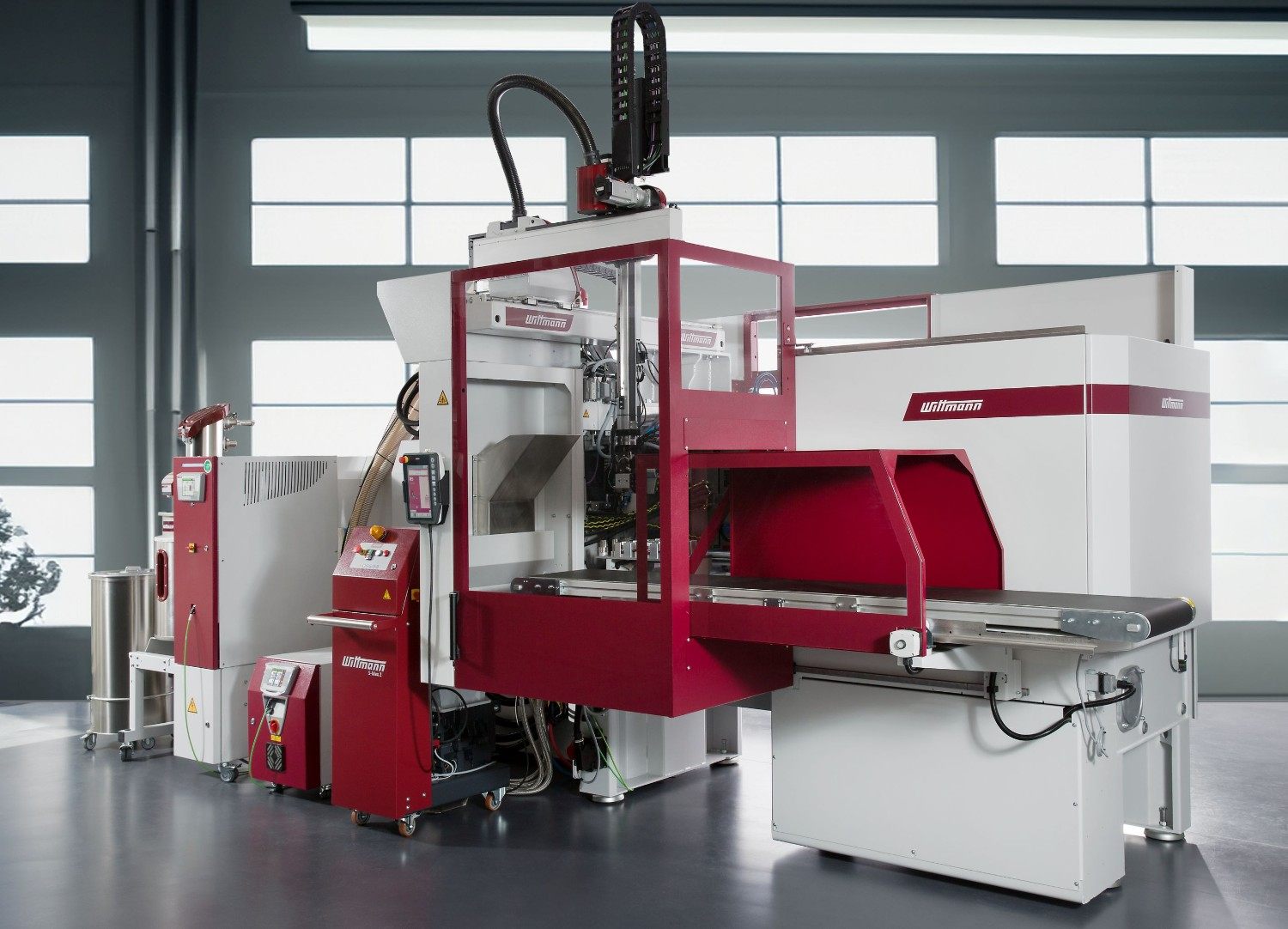
During the Fakuma 2026, the EcoFritz clamps will be manufactured live at WITTMANN’s exhibition booth—inside an Ingrinder work cell setting new benchmarks with this application in terms of production efficiency and sustainability. “Ingrinder” means that the injection molding machine, the robot, the conveyor belt and the granulator for in-line recycling of sprues and production scrap are already integrated into a single unit right from the factory. The protective housing is firmly attached to the machine, which enables a particularly space-saving arrangement of all process components.
The equipment used to produce the EcoFritz clamps will include a servo-hydraulic
SmartPower 60 injection molding machine, a WX90 servo parts removal device and an S Max granulator. Inside a 2-cavity mold supplied by Röttger, a glass-fiber-reinforced polyamide is processed using the Airmould gas-injection molding technology. The sprue is ground up directly in the production cell and mixed into the raw material as recycled content. This is a closed-loop material cycle. The sprue is recycled immediately without ever leaving the production cell.

Material transport is handled by a Feedmax Clean vacuum loader, which WITTMANN has specifically equipped with a very powerful dedusting system to meet the demands of the circular economy. When transporting recycled material, the Feedmax Clean achieves separation rates of up to 80 percent (for particles < 1000 µm), thus removing more dust particles and fine parts than any other comparable product on the market. Dust and other pollutants in the form of fine particles have a strong effect on the dosing process and reduce the homogeneity of the plastic melt. With careful dust removal, however, recycled materials can be safely used even in applications with high-quality requirements.
With highest material efficiency
In addition to dedusting, the digital assistance system HiQ Flow supports high quality consistency in injection molding. To this end, the software continuously analyzes the viscosity of the melt during the injection phase. If the measured value deviates from the set value, HiQ Flow immediately adjust the changeover point and the holding pressure within the same cycle. The result is a constant part weight in every cycle. In this way, any fluctuations in the raw material or in the environmental conditions are compensated before even a single piece of scrap is produced.
Internal gas pressure injection molding also supports extremely high material efficiency. In the Airmould process, nitrogen gas is injected into the cavity partly or completely filled with plastic melt. The pressurized gas forms a bubble inside the central area, which counteracts the shrinkage contraction on the outside and thus prevents the development of sink marks. By reducing the quantity of plastic material and generating a hollow space inside the molded part, light-weight parts can be produced effectively with a short cycle time and simultaneously good surface attributes. The quantity of internal material pushed out by the nitrogen gas is reground together with the sprue and subsequently re-processed within the production cell.

The nitrogen gas required for Airmould will be generated on site at the exhibition booth. N2easy will be used for this purpose. This nitrogen generator developed and manufactured by WITTMANN extracts nitrogen gas from the ambient air and then supplies it simultaneously to several consumers as required. N2easy already pays off from a daily nitrogen consumption of just one gas bottle, and thus dispenses with N2 supplies via road transport.
Climate-neutral production
At its Nuremberg facility, WITTMANN uses the weekends to produce EcoFritz clamps. The production at the German technical center runs autonomously and is climate-neutral whenever the sun shines, for it then consumes exclusively energy from the company’s own photovoltaic system. The proportion of recycled material reaches up to 100 per cent. To this end, scraps from injection molding tests and sample production are gathered and recycled on site.
EcoFritz clamps are available either in conjunction with auxiliary equipment or separately. They are manufactured in three different sizes to fit all commonly used corrugated hoses.
WITTMANN at the Fakuma 2026: hall B1, booth 1204
#wittmanngroup #modernplasticsnetwork #printmagazine #printpublication #pinterest #modernplasticsglobal